
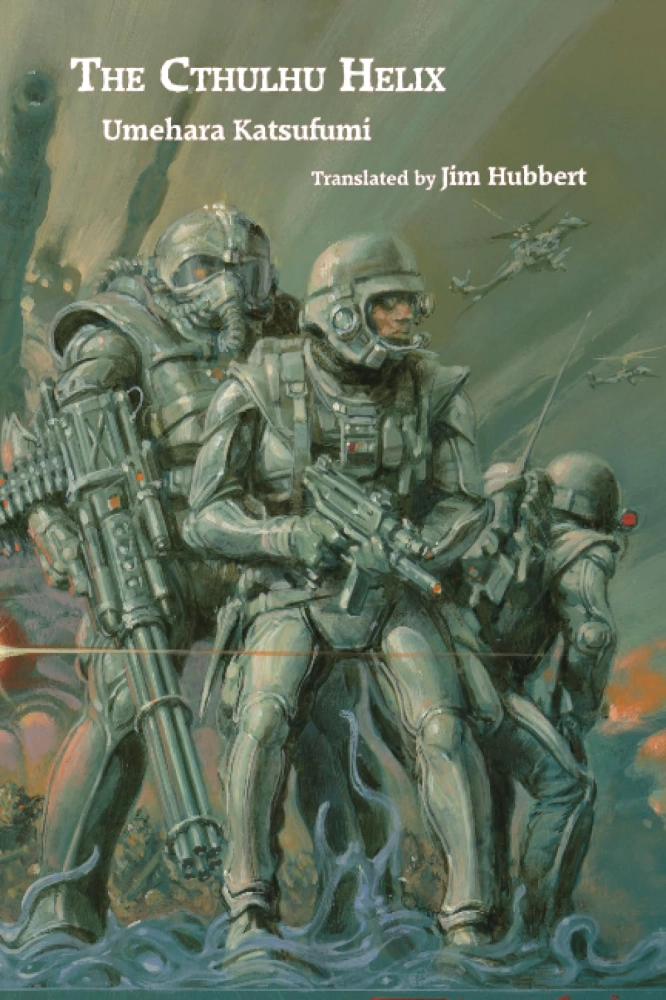
387 pages
Published by Kurodohan Press
I have to admit to a certain lack of enthusiasm when Kurodahan sent me a review copy of The Cthulhu Helix. I’ve never been much of a fan of H. P. Lovecraft (nothing against him, he just never got his tentacles into me) so a science fiction novel that riffs on some of his ideas and creations didn’t seem all that up my street. That said, proper Japanese science fiction in translation comes few and far between these days (by ‘proper’ I mean actual SF, not mildly weird occurrences with talking cats and otherworldly manic pixie dream girls) so I wasn’t going to turn my nose up at it.
The press release stresses that “while the book features name and concepts from the Mythos… it is entirely independent of it” which is reassuring and certainly true. I’m sure a Lovecraftite would find many more layers, Easter eggs and cross references than I did, but my enjoyment of the book wasn’t diminished by my lack of knowledge. This isn’t fan fiction, far from it.
Set in near-future Japan, the novel opens in a typical hardboiled noir style with self-confessed genius and “narcissistic coward” Naoki Fukao, our protagonist and first-person narrator. Fukao was a ground-breaking genetic engineer who, by messing around with the “junk” parts of human DNA, discovered—or more accurately unleashed—Lovecraftian monsters on the world. We learn this in flashback because these days Fukao has been co-opted by a Men in Black style secret government department called Bureau C (C for Cuthulhu) and spends his days fighting monsters whenever a too-curious genetic engineer releases one.
The first section, originally published as a stand-alone novella in the Uchujin fanzine, is a high-octane battle between Fukao and one of these monsters interspersed with flashbacks to his earlier career, his toxic love life, and the game of existential whack-a-mole Bureau C plays with these creatures. Expanded into an award-winning novel, it continues in the same vein with the stakes being raised each time as the monsters—renamed Great Old Ones when knowledge of their provenance comes to light—gain the upper hand and rain terror on humanity.
It is a real page-turner, with an unrelenting pace and high stakes, and so seems ready-made for a streaming platform. The classic military SF tropes—lashings of explosions, high-tech weaponry, and good old-fashioned last-gasp Hail Mary plays—sit comfortably alongside some real Hard SF science. Umehara clearly did a huge amount of research into the potentials of genetic engineering and isn’t afraid to show it. To know how much of it still holds up today (the original was published in 1993), you’d need an expert to say, but to this layreader it all seems coherent and legit enough to carry the story. It’s this combination of action and intelligence that really makes The Cthulhu Helix stand out.
It has heart and humour too, again in a hardboiled noir way. As the world falls apart, Fukao and the other world-weary cynics of Bureau C indulge in a lot of dark humour, as well as the kind of “you weren’t there, you don’t know” military friendships that will tug at the heartstrings as the body count inevitably ramps up. There is also a love story—one that Fukao doesn’t really deserve—running through it all, giving extra emotional heft to the end of days.
Umehara is relatively unknown outside Japan—as far as I can tell this is his first book to be translated into English—but on the basis of this evidence Kurodahan should translate more of his output. Pulpy original 1993 cover aside (the topless monster-woman on the back cover has nothing to do with the story and just seems gratuitous today, if it wasn’t already in 1993), The Cthulhu Helix and Umehara more generally deserves a much wider readership.