
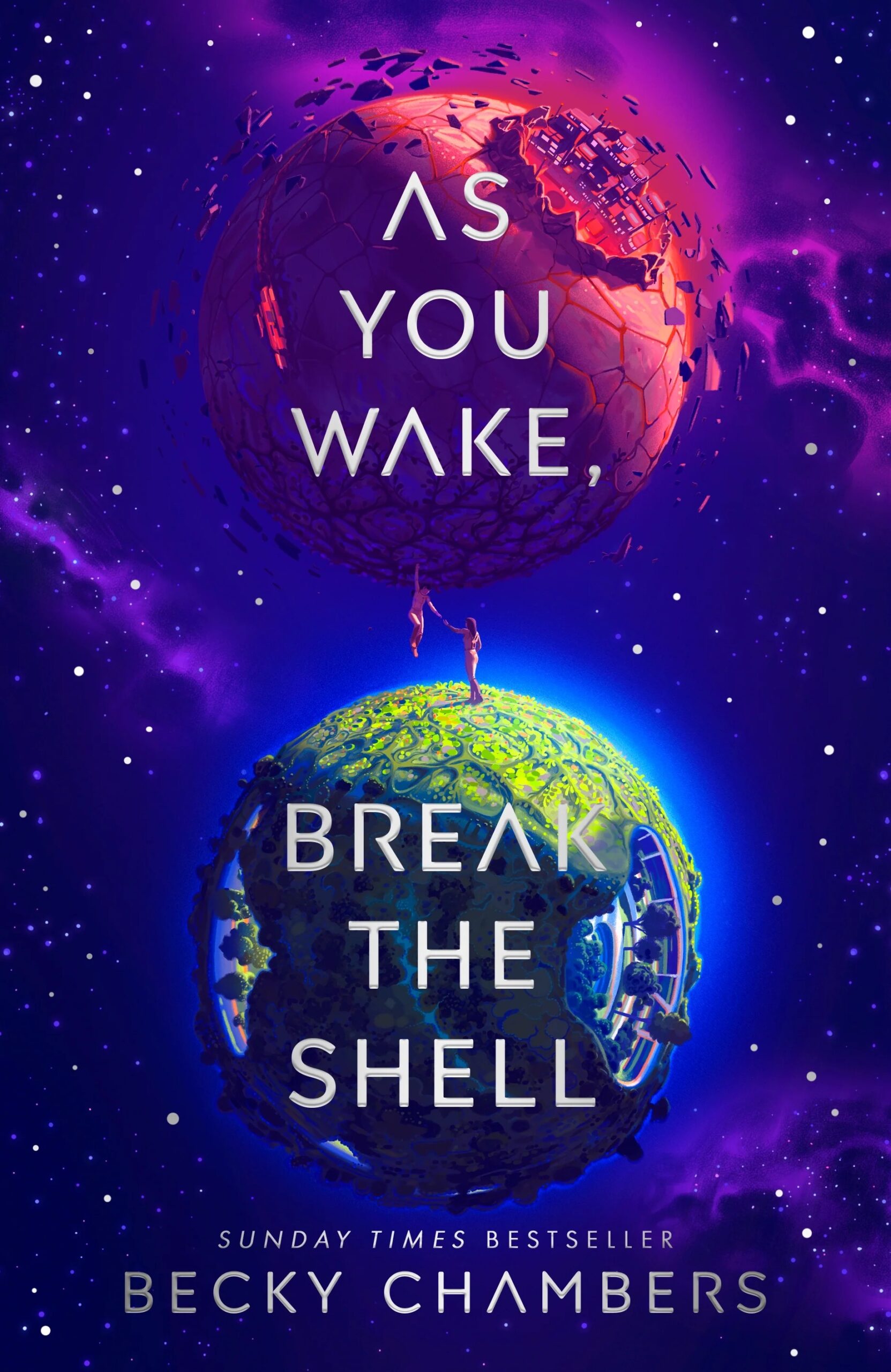
Published by Hodderscape in October 2026
Review by Lisa Timpf
Fortune is a strange name for an inhospitable planet. When Fortune’s atmosphere isn’t pelting its residents with noxious rain, volcanoes might be erupting. The land masses on Fortune are covered with a ‘perpetual fog of sulfur dioxide and cyanide gas’, as well as other unpleasant substances. Human inhabitants live in the Berth, a ‘clunky, teetering, hodgepodge city built on massive tethered rafts’ that float on a ‘murky sea’ within a crater.
Unwelcoming as it might seem, Fortune is the planet that Signy and Cora, the featured characters in Becky Chambers’s As You Wake, Break the Shell, call home at the outset of the book. Signy runs her own plant shop. She also uses her botany skills to develop plants that can be used for medicine to treat specific ailments. Her pharmaceutical sideline requires discretion, as it’s forbidden under the law. But Signy knows that many people get left behind by the medical system, so she is willing to take the risk.
Cora is a pilot, but not of a fabricated vessel. She guides a massive alien being called a rorqual, a creature that humans have harnessed to fill their own needs. Rorquals can fly through space and are capable of transporting enormous weights. Cora’s job is to pilot her rorqual, Colibri, to a moon from which ice is quarried, then bring the ice back to Fortune to provide water for the human colony.
While in the piloting ‘saddle’, Cora communicates with the rorqual through a special interface. Because rorqual thought patterns and perceptions are very different from those of humans, working with Colibri has created a problem called ‘mindbleed’, causing Cora to periodically be awash in alien perceptions. Cora doesn’t want to reveal her symptoms to her employer for fear that she will have to stop flying. Rorquals who are assigned new pilots don’t always take to them, and there’s a chance Colibri won’t be able to work with someone different. This would probably result in Colibri being put down, and Cora is unwilling to risk that.
Having heard about Signy’s sideline of providing medical aid through plants, Cora comes to see if Signy can help address her medical issue. Signy is suspicious at first, fearing that Cora might be an undercover law enforcement officer. But gradually the two of them come to trust each other, and there is a mutual attraction which develops into a relationship.
Chambers uses various structures to convey the story. The bulk of As You Wake, Break the Shell is conveyed through narration, but there are also sections written in other forms, like dialogue, snippets of advice given to rorqual pilots, recipes, a school assignment, text exchanges and so on. Rather than following a linear format, chapters depicting Cora and Signy on Fortune are interspersed with chapters about them later living in a hollowed-out moon called Cypsela. This was disorienting at first, but after the first few chapters I got used to it, and there is a logic to the structure. For example, the chapters on Fortune are sequential, as are the chapters on Cypsela. When I reached the book’s conclusion, the reason for the structure became clear, as Chambers’s way of telling the story allowed for appropriate timing for a critical event.
Besides telling an interesting story about a strange-to-us place, Chambers also shows her worldbuilding chops. The rorqual is one example. Colibri doesn’t have ‘eyes’ in the sense that we do. She ‘sees’ differently, and even perceives different colours. Colibri consumes gases instead of what humans would consider food. Her feeding station allows her to ‘eat’ helium, methane, carbon dioxide, ammonia and water vapour. But this is where Chambers makes the strange relatable. Colibri particularly enjoys ammonia, and if she is allowed to eat as much as she wishes she won’t get the balanced diet she needs. Because of this, Colibri’s feeding station limits her to a daily ration of ammonia. Her irritation when she goes to the ammonia station and finds that there is no more to be had is almost human.
As with some of Chambers’s other works, As You Wake, Break the Shell depicts the downsides of capitalism. As one example, rorqual pilots are faced with ongoing pressure to work faster, and the pilot ‘saddle’ attached to the rorqual while in flight includes a ‘prod’ that pilots can use to force the rorqual to do their will. While some pilots brag about using it, Cora does not, preferring to work with Colibri through persuasion rather than force. Both on Fortune and Cypsela, Chambers shows how building community offers a different way of securing and sharing resources.
As You Wake, Break the Shell continues Chambers’s pattern of writing enjoyable, imaginative and highly original novels that portray strange settings and different cultural and social twists. It introduces us to a new world, so it’s not necessary to be familiar with Chambers’s other novels to appreciate this one. As You Wake, Break the Shell is listed as the first book in a duology, so readers who enjoy this book can look forward to more to come.
Lisa Timpf lives in Simcoe, Ontario, where she writes poetry, book reviews, short stories and creative nonfiction. Lisa’s speculative poetry collections Cats and Dogs in Space (2025) and In Days to Come (2022) are available from Hiraeth Publishing. Lisa is a member of SF Canada and the Science Fiction and Fantasy Poetry Association. You can find out more about Lisa’s writing projects at http://lisatimpf.blogspot.com/. Lisa is also on Bluesky.