
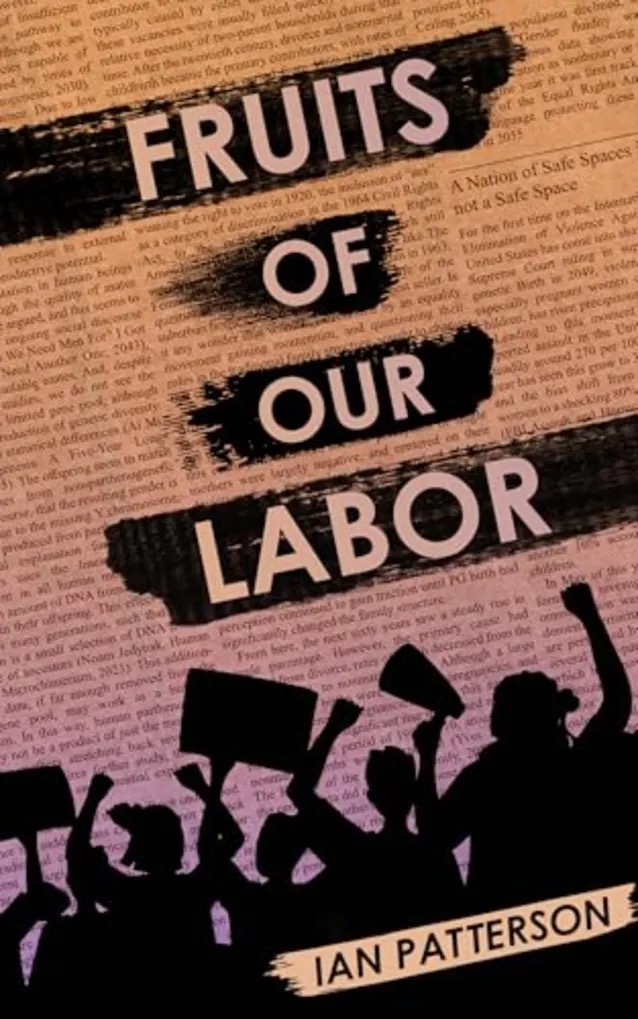
Published by Shiraki Press in August 2026
Review by D.S. Camperdown
Margaret Atwood and Naomi Alderman are responsible for two strands in speculative fiction that explore the experience of women in societies with diametrically opposed starting points.
The Handmaid’s Tale is the urtext of female oppression in a theocratic state. Its success has spawned novels such as Vox,Red Clocks and When She Woke, to name but a few. Atwood famously said nothing she depicted in the novel was invented. As a student, she’d studied the early Puritans of New England – a joyless bunch, by all accounts – and was of a generation that campaigned against apartheid South Africa. (When the book was released in 1985, the Taliban did not exist.)
Alderman’s The Power posits a world where overnight teenage girls develop a new piece of anatomy that enables them to electrocute people at will. Cue riots in Riyadh (about time, you might say) as Saudi women decide they’ve have enough, along with all sorts of other upheavals and an irrevocable change in the balance of power between the sexes. This, too, has inspired imitators, such as When Women Were Dragons and The Quickening.
Unlike the Atwood strand, which grows out of the frighteningly plausible, these later books depend on a Deus ex Machina event: women mutating into dragons or defying all the laws of evolution to spontaneously develop a new organ. In Fruits of Our Labor, they suddenly become capable of reproduction by parthenogenesis, or ‘virgin birth’. This startling phenomenon occurs first in an ordinary Latina woman, who, after a period of deep contemplation, finds herself pregnant without the intervention of her husband. Soon, women’s groups across the US are convening to discuss the implications and learn from each other how to meditate themselves a child. Somewhat predictably, this does not go down well with lots of men, who believe their entitlement to women’s bodies is under threat.
The book is told in part as two first-person narratives of women caught up in the societal upheavals. One is a report by an older academic for her daughter, who is a prominent politician. It includes ingeniously constructed scientific and ethnographic studies detailing the effects of this new form of human reproduction on US society. Some of these are so convincingly done I checked to see if they actually existed. This then segues into the first-person narrative of her daughter, a ‘partho queen’ bullied by some at school because of her ‘unnatural conception’. As a result, the daughter becomes politically active, and it is implied in the book her run to be POTUS looks set to be more successful than Hillary Clinton’s was.
One aspect of human reproduction not explored is how the bonds of our ‘biological family’ (as opposed to our ‘logical one’, as Armistead Maupin put it) might affect humanity in future generations. Presumably, men excluded from reproduction by parthenogenesis would feel no obligation in times of terror, war or famine to help the children conceived without them. Feminists would likely say women would rally around, yet what about female attitudes to parthenogenetically produced children? After all, many women are involved in the care of the offspring of their sons and grandsons.
While the premise of the book is intriguing, it is let down somewhat by its lack of character development. The women are mostly righteous, and the men dull or misogynistic or both, and conflicts seem quickly resolved with little sense of jeopardy. The one horrifying episode of male violence is carefully kept at arm’s length, the perpetrator getting his comeuppance almost immediately. If only that were true in real-life cases of femicide.
On my Edinburgh to London train journey scale, this is a Berwick-upon-Tweed.
D.S. Camperdown is a printmaker, tea drinker and recovering NHS drone.