
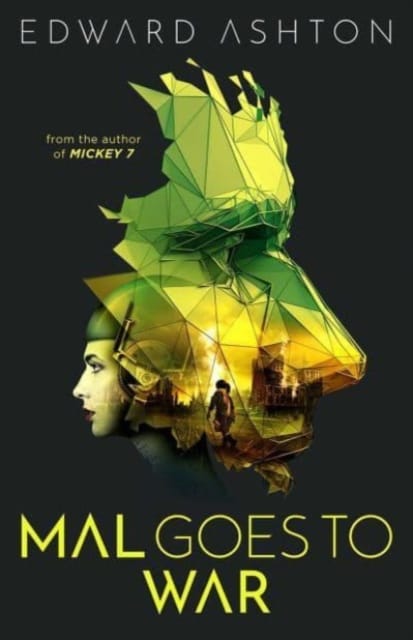
Published by Solaris in April 2024
Mal is a free AI and unconcerned about the war going on between the tech-embracing Federation and the tech-rejecting Humanists. Why should he be worried? He lives in infospace.
But his curiosity about physical forms and salvage gets the better of him; he finds himself cut off from infospace, ‘puppeting’ the body of a mercenary, in a hotly-contested war zone, in the company of the modded (modified) girl the mercenary was protecting. He takes it upon himself to see the girl to the safety of Federation-controlled territory, yet finds himself hamstrung by his reliance on immediate access to infospace, and his lack of connection to those around him. Of course, humans would never do that to themselves…
The story which follows is a surprisingly heartwarming exploration of comradeship, duty, honour, and friendship, as a ragtag group, willingly or not, forms around Mal; a very human tale, told from the perspective of a very inhuman protagonist. Or is he?
Machine- or robotic-based intelligences aren’t a new thing. Erewhon (Samuel Butler) was written in 1872 and we have gone through many iterations since then, both good and bad; Robby the Robot, Hal 9000, Iain M. Banks’ Culture series, Data in Star Trek, Rossum’s Universal Robots, Metropolis, and so on. However, it is perhaps unsurprising that in the current climate of rapid AI development, Science-Fiction is now producing more stories which feature an AI as the main character, rather than a straightforward enemy. Karl Drinkwater’s Solace series is another good example of this.
Ashton’s is certainly one of the best I’ve read recently. An all-too believable look at human physical and mental frailty, coupled with the inherent dangers of an artificial intelligence which neither understands that frailty nor, perhaps, wishes to – or worse, which might intend to exploit it. Mal Goes to War is predominantly written in the third person, but there is a level of laconic, wry humour which seems unmistakably Mal’s, no doubt helped by the short conversations he has with his friends, Helpdesk and !Clippy. These set the world-weary, or perhaps human-weary, tone for the whole book.
Don’t let the darkly comedic aspects fool you, however; this technothriller raises some serious and philosophical questions. Are Artificial Intelligences naturally cynical and slightly sociopathic, by our human terms? Should we use the same points of reference to judge them? What are honour and duty, and who do these serve? Indeed, it’s the differences in emotion, intuition, and logic between man and machine, whether in the theatre of war or on a personal level, which are the true driving force of the narrative.
The world-building is kept pretty simple, mainly taking place in rural areas and small settlements, and this allows the technical aspects to shine all the brighter; a spark is always more noticeable in the dark. There is more than a little of a cyberpunk leaning, here; innovative leaps from the wearable tech and military kit which exist in our contemporary lives, to those which could so easily come to be the everyday run-of-the-mill items and implants of the not-too-distant future. This isn’t ‘Hard SF’, though, the tale very much hinges on the interrelationships, and it is in the solidly-written, three-dimensional characters that Mal Goes to War excels.
It is also interesting to note that the whole thing was very visual. I can totally understand why one of the author’s previous novels, Mickey7, has been made into a film (Mickey17); I’ll be looking out for that one.
Ashton has created an extremely compelling, very readable satire on what it means to be human, the nature of war, and the future we might make for ourselves.