
Teaspoon Publishing
306 pages
Publication Date: 23rd November 2023
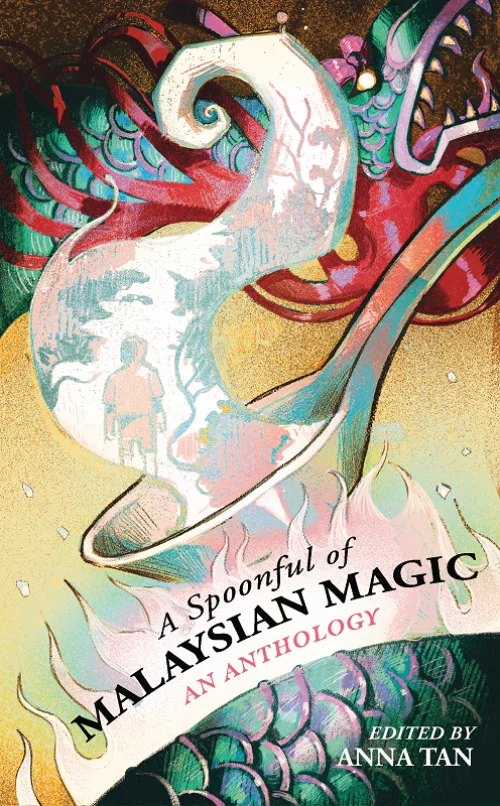
A Spoonful of Malaysian Magic, brings together twelve fantasy short stories by contemporary Malaysian writers. The driving force behind Teaspoon Publishing and herself a prolific fantasy author, Tan has made it her mission to promote Malaysian fantasy, which she sees as an underrepresented and neglected genre. Her aim in putting together this collection was ‘to find out what sorts of fantasy stories Malaysians were writing’, and – seeing as how the emergence of fantasy literature by non-western writers and/or incorporating non-western themes is a fairly recent phenomenon – what cultural references they were tapping into.
As it turns out, the majority of stories in A Spoonful… draw on Malaysian myth and folklore, with additional influences ranging from Japan and China all the way to Ireland. In Collin Yeoh’s finely crafted ‘The Rivers and Lakes’, an ageing kung fu master is visited by a prospective student hoping to be taught the skills he will need to overthrow ‘the corrupt and unworthy West’, only to find that the old man has very different ideas. Borrowing from Japanese manga, Syazwani Jefferdin’s ‘Flower Fell’ sees people suffering from what they at first think is hanahaki (‘throwing up flowers’, a fictional illness brought on by unrequited love), but what turns out to really be a curse placed on them by Mother Nature in retaliation for their bad treatment of her. Joni Chng’s ‘Moonlight City of the Hidden Ones’ features an Irish journalist following in the footsteps of his elf-obsessed father to track down Borneo’s ‘Hidden People’ – who, however, have moved on from the forests of Mount Kinabalu to a quite different location. Meanwhile, the protagonists of Rowan C’s ‘Taxation’ inhabit an entirely fictional realm based on the Dungeons and Dragons roleplaying game.
Even the stories inspired by the myths and traditions from the Malay Archipelago are very versatile. Joshua Lim’s ‘Kampar and the Kings of Kedah’ and Julia Alba’s ‘The Fiery Tale of Embun and the Prince’ with their shapeshifting heroes, evil rulers, and magical animals almost read like straightforward fairytales, whereas Zufar Zeid’s ‘Visitor in the Night’ and Hamizah Adzmi’s ‘The Dahlia of Hutan Kilat’ put the encounter between the mythic and the modern centre-stage. While both of the latter are imbued with a strong sense of melancholy caused by the advancing loss of natural habitats (and, consequently, the magical beings that inhabit them), ‘The Dahlia…’ manages to also draw out the comic potential of such an encounter, such as when a dragon has trouble using a mobile phone, or when vengeful spirits give relationship advice to a celestial being-cum-forest guardian.
The only full-on comical story is Ilnaz A. Faizal’s hilarious ‘Rosetta and the Fairy-in-Training’, in which an overzealous apprentice fairy tries to bestow her gifts on a less-than-grateful recipient, causing utter chaos in the process. However, as Tan notes in her introduction, ‘hope’ is a major theme in the collection as a whole, and even most of the more sombre stories end, if not on an upbeat, then at least on a cautiously optimistic note. Old friends find themselves unexpectedly reunited in Ismin Putera’s ‘Burong’; a young would-be wizard finds a way to overcome his society’s inherent racism in Stuart Danker’s ‘Up in Flames’; and a woman saddened by her own lack of magic discovers the liberating power of grief in Sharmilla Ganesan’s beautifully written ‘Remembering How to Cook’. Interestingly, another theme that comes up repeatedly is that of the conflicts created for the protagonists when their sense of duty clashes with a force pulling them in a different direction, be that duty vs. conscience (‘Kampar and the Kings…’, ‘The Dahlia…’), or duty vs. love (‘Taxation’).
As tends to be the case with edited collections, some stories will appeal to some readers more than others. I personally found ‘Burong’ quite hard to follow for the way it skips between short episodes featuring different characters, some of whom only get a proper introduction quite late into the story, and I felt that Jefferdin was short-changing her characters rather by wrapping her intriguing story up so abruptly. There is, however, more than a spoonful of magic in this diverse anthology to dazzle and delight the reader, and the Malaysian angle certainly gives it a special appeal (not to mention the lovely illustrations by Yura and gorgeous cover art by Amita Sevellaraja).
If you’re tired of reading about swords and wolves, and you’d like to try kerises and weretigers instead; or if you enjoyed Shoreline of Infinity’s Climate Change issue and would like to read some more stories that imagine the relationship between the human and non-human in positive ways, this is the book for you.