
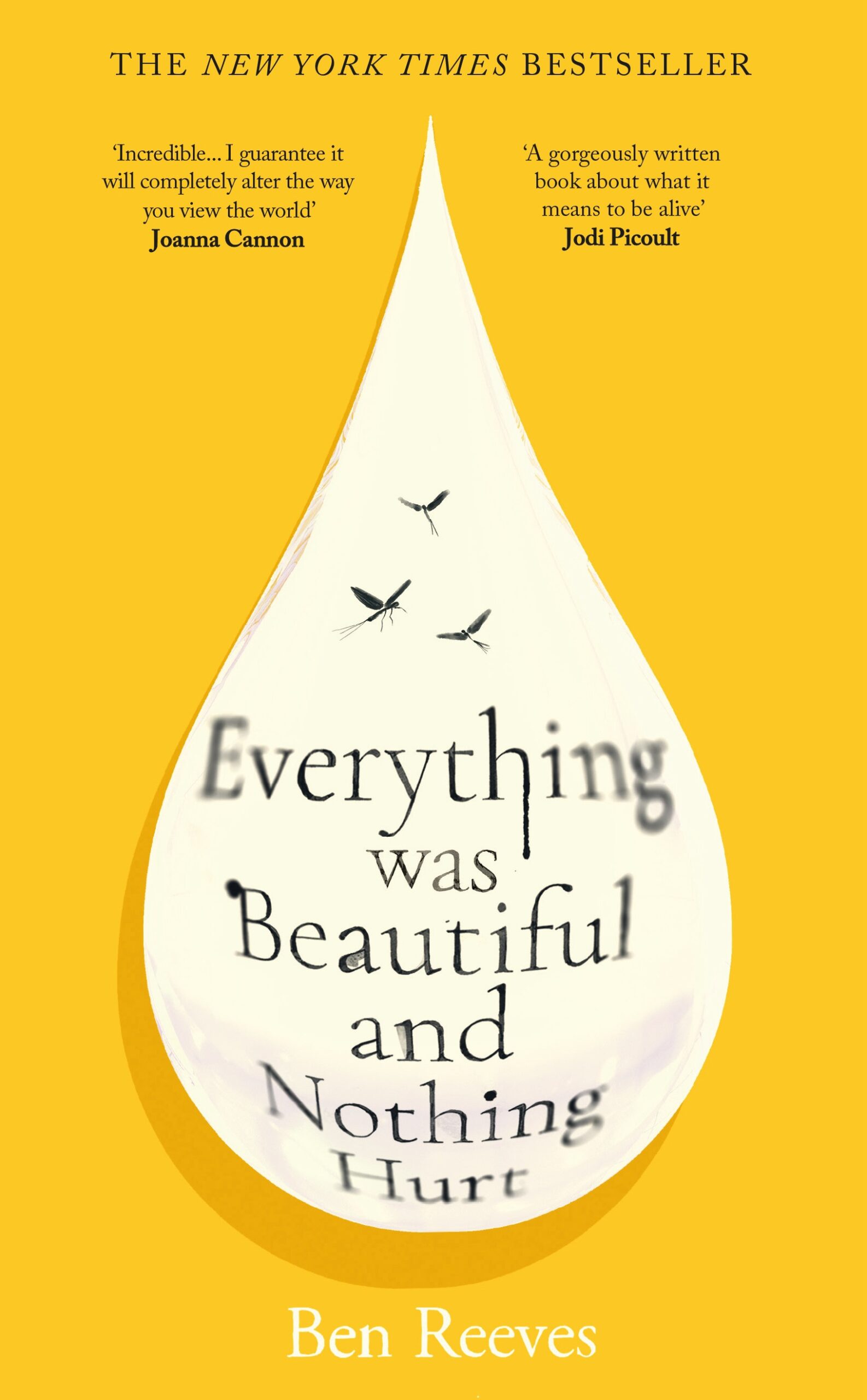
Published by Atlantic Books in July 2026
Review by Lisa Timpf
Reeves’s debut novel offers a different view of death
When I was an undergrad, a friend introduced me to Piers Anthony’s novels, and I found myself intrigued by the concept of On a Pale Horse. This book, the first in Anthony’s Incarnations of Immortality series, portrays a person named Zane who assumes the guise of Thanatos, or Death, after killing the previous incarnation. Since then, interested in seeing how other authors play with the same concept, I’ve read several other novels that explore a personified Death, including Cate Lawley’s Death Retired Mysteries series, enjoying the humour, and the first two volumes of Maxie Dara’s S.C.Y.T.H.E. mysteries. So, when I heard about the premise of Ben Reeves’s Everything Was Beautiful and Nothing Hurt, I knew I had to get my hands on a copy.
Reeves’s book portrays the cosmic force of Death as being personified in a human named Travis Smith. Like Zane in On a Pale Horse, Travis is endowed with unique capabilities. While walking the streets, Travis notes, ‘I’m inside everything, everyone, everywhere, between it and through it, every seed in every pod, every fragment of gravel, that blade of grass leaning against that blade of grass. While the Lawley and Dara books take on a mystery format, Everything Was Beautiful and Nothing Hurt is more philosophical, musing on humanity’s ephemeral nature and the importance of valuing the time we have here on Earth. Like the other authors mentioned, Reeves portrays Death in an empathetic way. When Travis shows up to shepherd someone out of this life, he offers words of comfort and reassurance. Though not everyone feels ready when their time arrives, some are depicted as welcoming, or at least accepting, Death as a part of life.
Travis doesn’t just visit people who are about to die. He also spends time with others, often the lonely or elderly, making tea, sitting down for a chat or doing the dishes. Travis spends his spare time restoring photos for people, which I interpreted as a way of helping them stay in touch with their most precious memories. While working on one person’s photographs, he notes, ‘I know, of course, who each of these people is – I have met almost all of them, and over time they have known me by different names, in different shapes. I will meet the rest of them before long.’
Some people beg Travis for more time, but he is helpless to offer that. Reeves depicts him as being constrained by his role. One character challenges him, asking, ‘Is it even your decision? Do you choose who stays and who leaves?’ Travis refuses to answer, which is an answer in itself. Travis has a duty to perform, and he never questions that, until he starts getting close to the family who lives across the hall, single mother Dalia and her daughters Layla and Neda.
Sometimes the action focuses on Travis’s interactions with Dalia and her family, though we get the sense that there’s a reason he thinks he shouldn’t allow himself to become emotionally involved. Other times, we see scenes of Dalia (a key character in the book) interacting with her exes, her kids or her co-workers and patients at the hospital where she works as a midwife. Through his relationship with Dalia, Travis becomes more attuned to the impact of his actions at the individual, human level.
There are everyday scenes, like visits to the Community Garden or Travis’s walks through the town, in which Reeves describes Travis’s impressions in vivid imagery that is also lyrical. Though most of the scenes deal with humans, there are some depicting nature. Here, Travis sees both the good and the bad, the beautiful and the ugly, and loves it despite the contradictions. Scenes depicting mayflies are among the most compelling of the natural-world reflections.
Among my earliest exposures to literature around death were the writings of John Donne and Dylan Thomas. While ‘Death Be Not Proud’ and ‘Do Not Go Gentle into That Good Night’ rail against death, Reeves shows us a more empathetic, compassionate version, one who offers comfort at the end. Rather than being ‘proud’ of the devastating impact he sometimes has, Travis is troubled by it, so much so that sometimes he is compelled to ‘wander the streets like a stray cat’ while he wrestles with his thoughts. When asked, Travis acknowledges that he finds the job difficult and lonely. This makes him seem more human, despite his powers.
I didn’t see content warnings in the copy of the book I read, but will offer some here. The novel contains depictions of suicide, suicide ideation, substance abuse and violent forms of death (like motor vehicle accidents). These are not the focus of the book and are portrayed with sensitivity, but readers for whom such scenarios might be triggering should be aware of their presence.
Everything Was Beautiful and Nothing Hurt is a debut novel for Reeves. An earlier draft of the novel won the Bath Novel Award in 2024. You can tell a book has been impactful if you find yourself thinking about it well after you’ve read the final page, and this book accomplished that. Thoughtful and at times lyrical, Everything Was Beautiful and Nothing Hurt proved to be an enjoyable and thought-provoking read.
Lisa Timpf lives in Simcoe, Ontario, where she writes poetry, book reviews, short stories and creative nonfiction. Lisa’s speculative poetry collections Cats and Dogs in Space(2025) and In Days to Come (2022) are available from Hiraeth Publishing. Lisa is a member of SF Canada and the Science Fiction and Fantasy Poetry Association. You can find out more about Lisa’s writing projects at http://lisatimpf.blogspot.com/. Lisa is also on Bluesky.