
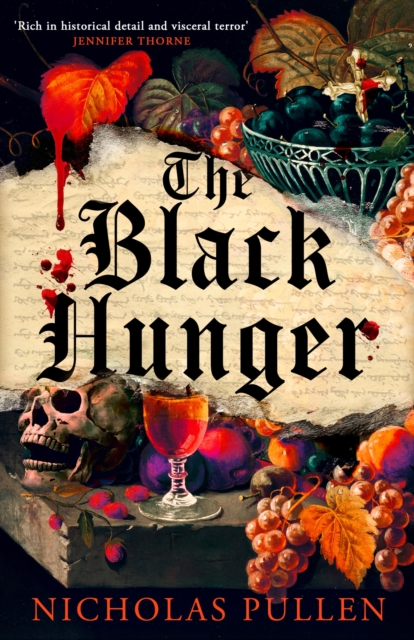
Published by Orbit in October 2024
Review by D.S. Camperdown
The Black Hunger is a cleverly constructed Gothic romance whose narrative structure resembles Mary Shelley’s Frankenstein. Don’t be put off by the lurid back cover blurb: this book is both much more exciting and more sophisticated, being a nimble combination of fictional characters and events intertwined with actual historical individuals and affairs.
It opens with John Sackville, its protagonist, recalling from his prison cell his idyllic late-nineteenth-century childhood as the only son of minor, and very enlightened, gentry. They don’t send him to be brutalised at a public school, and neither do they seem curious about Garret Benson, the local tenant farmer’s son, with whom John spends a great deal of time.
As expected, John goes to Oxford, taking Benson with him as his, ahem, valet. At Oxford, John meets Sidkeong, a quiet Indian student, and develops a passion for Sanskrit and ancient Tibetan and Buddhist manuscripts. During one of his reading sprees, he comes across mention of an obscure Buddhist sect, the Dhaumri Karoti. Convinced he is on the verge of making a significant contribution to scholarship, John shares his discovery at high table one night in front of his tutor and the mysterious Russian Count Vorontzoff, blithely unaware of the fact he has reduced the room to silence.
Fascinated by the East, he joins the Indian Civil service and is posted to the Kingdom of Sikkim in the foothills of the Himalayas. There, he meets his old friend Sidkeong, who, to his surprise, is the heir to the throne of this semi-autonomous principality. John seems set for a career of gentle bureaucracy, diplomatic receptions, and scholarship when Sidkeong dies in mysterious circumstances shortly after ascending the throne. A few weeks after witnessing his cremation, John finds a letter in his house apparently from Sidkeong, telling him of his reincarnation. While puzzling over this, John is caught practising a bit of the love that dare not speak its name with Benson and is blackmailed by the British secret service into undertaking a perilous quest to Tibet and Mongolia to retrieve artifacts, including a cavalry sword, the only protection against the Dhaumri Karoti and their plans to bring about the end of the world.
The novel then reels back in time to two long letters detailing the activities of this evil sect and their previous attempts to destroy mankind. The first describes the journey to Orkney of a Jewish physician, Dr Samuel Abravanel, who has been summoned to declare a grieving widow (and former sweetheart of his) lunatic, prior to her commitment. This being a Gothic novel, it turns out the widow is perfectly sane. Being Jewish, the doctor avoids eating some dodgy-looking meat during a supper date with a mysterious Count (Vorontzoff), which means when the whole situation goes Wicker Man at the Rings of Brodgar, he is able to make himself useful.
In a short lull after saving humanity, Dr Abravanel gets round to reading the (it turns out not so grieving) widow’s husband’s last testament, detailing his experiences after being captured in the Crimean War and sent to live with the aristocratic Vorontzoff family in Ukraine. At this point, the book really hits its stride. Think Hammer Horror on acid. A Gothic mansion in the middle of a snowy wasteland, sinister servants, a raven-haired but distant daughter of the house, mysterious sounds from the chapel in the basement, serfs hunted at midnight followed by hearty breakfasts of tasty sausages, all capped off with a thrilling chase across the steppe in a horse-drawn sled pursued by wolves and something much, much worse.
At this point, John takes up the story again as he and Benson travel to Mongolia via the court of the Dalai Lama to confront Count Vorontzoff and the leader of the Dhaumri Karoti, the completely unhinged Count Ungarn, along with a reincarnated Sidkeong and at least one lustful Lama.
The whole confection is fantastic fun. Nicholas Pullen says his inspiration was in part Susanna Clarke’s Jonathan Strange and Mr Norrell. He certainly has pulled off the difficult trick of intertwining fictional with real-life characters. Count Ungarn, Sidkeong, the thirteenth Dalai Lama, and Sir Charles Bell, John’s superior in Sikkim, all existed. As the novel suggests, Sidkeong may well have been murdered on the orders of the British, and, by all accounts, if the real Ungarn had not met his end at the hands of the Soviets during the Russian civil war, he’d probably have been a serial killer terrorising suburbia.
Mr Pullen writes very well. There are a few stylistic lapses – I doubt any Victorian or Edwardian ever said ‘A good fit’, or ‘Putting yourself in harm’s way’, or the ghastly ‘impacted by’, and Russian Orthodox churches don’t have pews – which, however, don’t detract from the book’s enjoyment. Reading it, I was reminded of the fluent prose and effortless storytelling of another Canadian, Robertson Davies, who also had an interest in magic and spirituality.
Be very careful if you take this page-turner on a long train journey. You may miss your stop.
D.S. Camperdown is a printmaker, tea drinker and recovering NHS drone.