
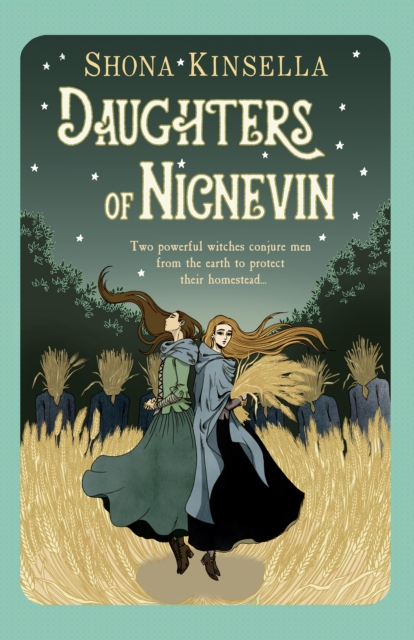
Published by Flame Tree Publishing in November 2025
Review by Meghan Ellis
Shona Kinsella’s Daughters of Nicnevin asks a difficult question: how far would you go to defend your loved ones from the ravages of war? For Mairead and Constance, two Scottish witches living in the long shadow of the trials, the answer is as bewitching as the consequences.
Faced with the Jacobite rebellion and the problem of a farming community with no able-bodied men, the villagers of Kilmartin band together to make the ‘Albans’: animated golems created from fae magic and the soil and stones of their home. Compelled by Mairead and Constance’s magic and given form by the fae queen Nicnevin, the Albans become a source of strength for the remaining villagers. But these earthen men are also a source of increasing tension, and capable of shocking violence. As the surrounding Highlands become more dangerous through the activities of the Black Watch and raiders alike, our witches must wrestle with how far their morals stretch in self-defence.
This story is not Kinsella’s first flirtation with the witches of Scotland. Her novel The Heart of Winter follows a crofter as she evades an unwanted marriage by pledging herself to Cailleach, the Queen of Winter. Set during the blurring of pagan and Christian religion, young Brigit lives in a world far removed from Mairead and Constance, but there’s a common thread throughout both books of women resisting the paths shaped for them by society. In each tale, the young witches are aided by the mysterious Nicnevin, a mythical witch queen adapted from Scottish folklore.
Here, Nicnevin is a being from another time. She’s far removed from the god-fearing reality of 1700s rural life, where women were wives and mothers before all else. Everything about her is powerful and wild, and she is an alluring metaphor for living life freely. Daughters of Nicnevin is a story about love between women in many forms – motherly, sisterly, sapphic – and the witch queen ties all these together with a touch of fae danger. She is salve and sting at once, like any good Scottish fairy should be.
Aside from the Albans, Nicnevin is almost the only visible magic in the novel. The natural powers of Mairead and Constance are shown through their outcomes, such as the influencing of behaviour or the movement of a scrubbing brush. There are no flashy sparks, no pentagrams or floating candles or feisty familiars. It’s subtle, manipulative, and secretive (perhaps too much so, in Constance’s case, but I’ll leave that for the discovering). After all, why would women living in the decades after the witch hunts risk their magic being seen as something to be fought against? This adds a wonderful element of realism to the book, drawing the reader into truly reckoning that there were witches in the Highlands, back in the day. Presented alongside extracts from fictional-but-believable papers such as The Inverness Daily and letters from men on the front at Culloden, Kinsella knits together Mairead and Constance’s struggles with a Scotland that’s fantastical but familiar.
If I had one thing to point out, it’s that as much as Daughters of Nicnevin is a lush and rhythmic tale, there are a few threads that aren’t as tightly tied into the weave. An intriguing moment early in the novel sees Mairead encounter a will-o’-the-wisp, those mischievous spirits said to tempt people from the right path. Nicnevin tells Mairead that it’ll aid her when the time comes, but I didn’t find that promise materialised. I wanted to know things like why the Albans only spoke to Constance, and what they were saying, but the novel doesn’t really delve into the complexity of artificial life, or the true horror of creating it at all.
There is also an undercurrent of Nicnevin favouring Mairead that remains unexplored and unspoken. The fae queen is such an arresting character, and I wanted her to use that power in some way. I certainly preferred her for Mairead rather than Constance, a complex, calculating character who slipped into toxic behaviour, but who ultimately redeems herself towards the end of the novel.
That said, most of my qualms stem from wanting more, which is proof that there’s an engaging story here, and definite appetite for further stories of witches and their survival in an often-cruel world. Kinsella has a great universe on her hands, and I’m keen to see where it goes next. Imagine, for example, witches at the evacuation of St Kilda, or during the Viking raids on the Hebrides.
But whether or not there is more planned for this fictional Scotland, Daughters of Nicnevin is at its best a compelling, female-centric take on a history that is often dominated by battles fought and the men who fought them. Haunted by the rebellion and the perils of dealing with the monstrous, it is an exploration of how love, magic, and community can help protect the women left behind. Read it for sapphic witches, for Highland wind and rain, and for sharing a dram after a hard day’s work.
Meghan Ellis is a Glasgow-based journalist covering internet culture, anime, gaming, and SFF. She’s appeared in IGN, Kotaku, All the Anime, Tabletop Bookshelf and on the BBC, where she brought the joy of fandom to the general public. She’s a member of the Glasgow SF Writers’ Circle, and writes about extraordinary things happening to ordinary people. Read more of her writing on her website