
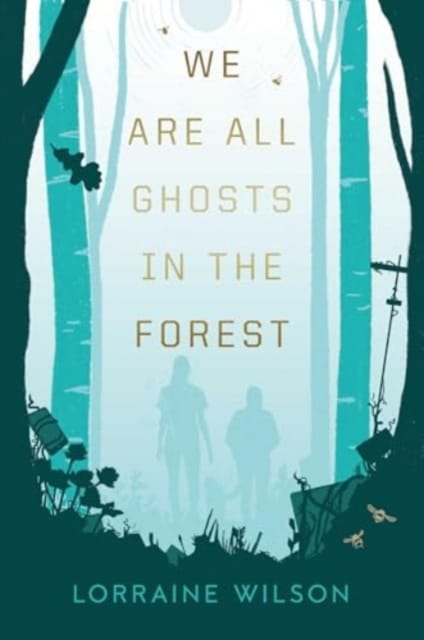
Published by Solaris in November 2024
We Are All Ghosts in the Forest is a post-apocalyptic science fiction novel with fairytale overtones by Scotland’s Queen of the Slow-Burner Lorraine Wilson.
Living alone in her grandmother’s cottage at the edge of an Estonian village, photographer-turned-herbalist Katerina talks to the bees and makes remedies for treating the locals’ various ailments – and for keeping away the digital ‘ghosts’ that are the only remnants of the once-all-encompassing internet, and which, given the chance, will possess the people they come in contact with, with deadly consequences for the people. Regarded with suspicion by the other villagers because of her Indian heritage, and with trauma haunting her past, Katerina is happy to keep to herself – until the day a silent boy presses a note into her hand in which his father implores her to take care of him. Except Katerina has no idea who the father is.
On the post-apocalyptic scale, We Are All Ghosts… sits right at the opposite end from Mad Max. There are no big explosions, no outlandish vehicles, no roaming gangs of outlaws, and nobody wears leather. (The only thing that comes even close is a motorbike the protagonist gets to ride for a bit.) Everything is much as it was before the collapse, except that the disintegration of the internet has confined people’s lives to the local level, with improvisation filling in the gaps left by any systems that used to rely on digital communication. The mood is contemplative, the pace deceptively slow. For the first third or so of the novel, not much seems to be happening at all, as we follow Katerina in her day-to-day tasks, looking after her animals, dealing with her neighbours, and reluctantly caring for her young charge Stefan.
This, however, is where Wilson’s genius as a writer reveals itself. Despite the slowness, none of it is ever boring: almost imperceptibly, the story is constantly evolving, as the consequences of Stefan’s appearance in Katerina’s life ripple in the past as well as the future, steadily broadening the picture, shedding light on the relationships that have shaped (and continue to shape) Katerina’s reality. Like Wilson’s novella The Last to Drown, which, if possible, is even slower-paced than Ghosts, Ghosts had me thoroughly hooked throughout. If anything, the resolution almost seemed to come too soon, at a point when many things still hadn’t quite worked themselves out (most notably, perhaps, the relationship between Katerina and Stefan’s mysterious father, Aleksander).
In a way, Ghosts is a kind of inverted ‘Little Red Riding Hood’. Instead of a little girl trying to reach her grandmother’s house in the woods with a basket full of food and drink, we have a heroine already firmly established at her Baba’s cottage (located at the border between forest and village), from where she distributes the remedies she makes based on her Baba’s recipes. The question is not whether she will be able to reach the grandmother’s house, but whether she will be able to stay there: with the arrival of Stefan, the villagers’ hostility towards Katerina grows as they worry about viral contagion from outside, and, in time-honoured fashion, they turn her healing knowledge against her by accusing her of witchcraft. This knowledge has not been passed on to her – Baba, we learn, was not a loving granny like Little Red Riding Hood’s, but felt about Katerina and her sister much as the villagers do, with Katerina only taking over her cottage after her death. All that Katerina knows, she has learned from consulting her Baba’s old notebooks, along with an intuition attuned to the intentions and properties of the non-human, whether that be plants, bees, wolves – or ghosts.
The ghosts, it turns out, are an integral part of the new, changed nature surrounding the village. Where in the world of fairytales the woods are dangerous because there are wolves in them, the forests in Ghosts have become a danger in themselves, changed irrevocably by the absorption of the digital ghosts that wander around forlornly in search of connection and meaning. One crucial thing that sets Katerina apart from the other villagers is her ability, and indeed her willingness, to enter into a dialogue with the potentially dangerous entities around her. To the constant exasperation of her friends, she quite happily lets her bees swarm all over her, enters the forest to talk to the monstrous trees, and even approaches ghosts for information they may have picked up in the fragments of whispers that still occasionally reach them from elsewhere.
Beautiful and profound, Ghosts, is one of those books that can be read in many different ways, a veritable layer cake of meanings. (And it would be worth rereading for the writing alone!) I read it as a kind of thrutopian fairytale for the Anthropocene, an exquisitely written meditation on the need to see our changed world for what it is and engage with it in constructive and compassionate ways. When Katerina reluctantly sets off to find the family she never knew she wanted, it is precisely by straying from the path that she reaches her goal. ‘We’re the same,’ she says to the altered wolves that threaten to tear her friends apart: we are all part of this world, and we can find ways to live with each other – and ourselves.