
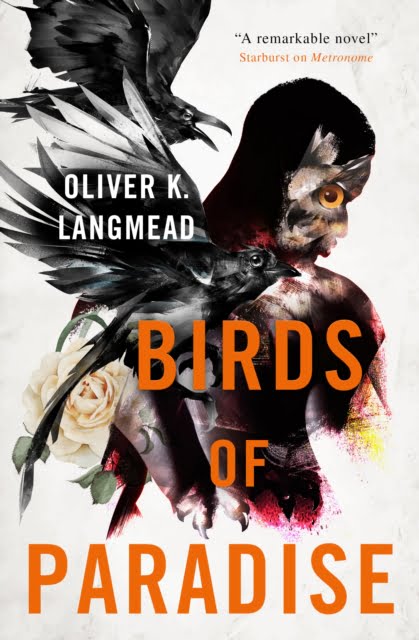
Published by Titan in April 2021
Life, both animal and vegetable, from the Garden of Eden—the literal Garden of Eden—is still around and scattered throughout the modern world. That’s the premise of Birds of Paradise: that the rose of Eden has been forever blooming through the ages, that “Owl” and “Pig” and “Rook” survive in perpetuity, and that Adam, full of scars and old bullet wounds, can still remember the garden if he stretches his mind to its limits.
This premise alone is loaded: such biblical figures do not belong in the modern world, having been made (in the book’s parlance) before the invention of death, and yet—unlike other tales involving fantastic visitors—nor are they totally outsiders. Arguably, they are just the opposite: Adam has an original claim to humanity via the myth from which we know him, making it us, his modern ancestors, who don’t belong. Who is a derivative of the other? Whose Earth is it? This perspectival tension forms an undercurrent of electricity that lasts throughout the book.
The story itself is built simply. Don’t expect multiple perspectives, subplots, timestreams, or a lot of out-loud reasoning. We follow Adam from start to finish, we see what he does and how he does it, and only sometimes do we understand why.
That question—why?—is indeed the novel’s central force, beginning in nearly the first scene. Admit commits a murder in cold blood, his victim a screenwriter who had been harassing a starlet at a party. But the idea isn’t to savour vengeance against a sex-offender: “When Adam kills Damon Darcy, he feels divorced from the action, as if he is simply watching another scene from the movie.” These characters fade from relevance almost immediately, and although Adam is carted off to prison he remains at a remove from the world; the novel doesn’t bother to digest the ethics of what happened. Death, it seems, is merely part of the minutia of Adam’s long, long life. When you read that Adam “feels divorced from the action,” you can safely extrapolate that what he really feels divorced from is the human species. The question of why Adam killed Darcy soon balloons into others: Why does Adam lack compassion for his “children”? What does Adam want out of his strange, near-immortal existence? What could—or ever did—create meaning in Adam’s life? That these macrocosmic questions are answered with concrete turns of plot creates an interesting feeling of vertigo in the narrative.
Soon, the framework of the story takes shape: certain collectors have been amassing bits of the original garden, recreating Eden here in the twenty-first century. Adam is drawn to the project but it doesn’t become his motivation as a character. Rather, he begins to cut a warpath through the group of rich people doing the collecting. Partly he is on a journey to understanding and partly he is filled with ideas of Eve, whose absence is conspicuous. The first woman is indeed another driving question for Adam, and one that ultimately helps resolve the entire narrative. Her story appears, unfortunately, to amount mostly (merely) to existing as an element of Adam’s character, the narrative ending when the male protagonist reaches a note of personal understanding about a woman he loves, but you can nevertheless appreciate the subtle ways in which she complicates the book’s themes of life, death, and modernity.
The villains of Birds of Paradise might furthermore be a little easy to loathe, made of straw or perhaps conceived in the heat of cynicism. But their one-dimensionality, although frustrating, keeps the narrative simple and further focuses our main source of tension, i.e. Adam’s headspace—while their straw qualities also help declassify the violence committed, lending the book a fabular coldness as the various parties rip into each other.
Perhaps the above observations can be gathered under the suggestion that the narration has glances of a parable and the anonymity associated therewith, which forces a “literary” reading that seeks meaning in actions rather than in characters. For me, that’s a tougher and more abstract row to hoe, but it’s attractive and to have this particular perspective in a book that reads, on a plot level, almost like a revenge thriller.
In all, Birds of Paradise is a page-turny meditation on human nature, modernity, and perhaps nostalgia. Langmead continues to fascinate after his debut, Dark Star, and proves himself a trustworthy provider of strange and well-paced stories that reverberate long after you’ve put them down.