
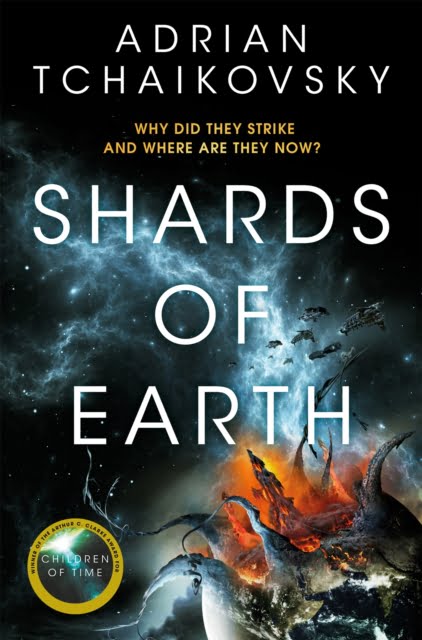
Book 1 in The Final Architect Series
Published by Tor in May 2021
What might, in the wrong hands, be elevator-pitched as just another space opera starring a prefabbed complement of misfits (a cyborg, a test-tube baby, a crablike alien, a few wayward humans) is really a triumph of worldbuilding, plot, and tension. Admittedly, I had my doubts: from page one, you know you’ve signed up for a war-of-the-species plot greased together by a star-jumping gang of “spacers,” each threatening to be a little more Han Solo than the last. (“Rollo Rostand was a stocky, square-faced man, brown bronzed by decades of low-level radiation exposure, his hair and moustache wispy and dark grey.”) Immediately fun, but could it anchor my attention for half-a-thousand pages?
Short answer: yes. Not only are the plot beats hit hard and in rhythm, but the book also manages, and in understated ways, to engage with the social zeitgeist.
Essentially, something out there is hunting intelligent life in the universe, humankind included: moon-sized aliens that travel though “unspace,” a kind of fabric that exists underneath the real, can turn up in a star system unheralded and ready to deal planetary deathblows. Cool. Also fascinating: the aliens exist on a scale entirely different to humankind, with a size, age, and mind cannot be fathomed. Even Idris Telemmier, the “intermediary” of the circle of protagonists (who alone is cranially equipped to do business with these giants), can only stab into their minds for painful moments at a time. The way these uncanny hunters cannot be mentally reckoned with in one shot, or even seen at one time—hanging as they do half in unspace—conjures up Timothy Morton’s hyperobjects, at least in an atmospheric sense: they’re glimpsable and real, but fundamentally unknowable. In keeping with the menacing aspect of such a mysterious power, the novel’s present-day plot is founded on a moment seventy years earlier when one of these alien giants, known as Architects, destroyed Earth—which it did by turning our planet into an austere, gorgeous, lifeless sculpture. Reason: totally unknown.
Thus severed from the Earth, humanity now exists only in a periphery of other worlds and amongst a plethora of bedfellows: the crablike Hannilambra; the wormlike Castigar; a parthenogenetically grown bloc of battle-oriented and superior-gened women; swarms of sentient insects in cyborg frames; and, believe it or not, others. In its backdrop, then, the book trades in a humanity that cannot but exist on the toes of some other: they have to live on planets that aren’t Earth, fly on ships navigated by biologically altered pilots, vie with aliens of all stripes, negotiate with parahumans. Add to that the existential threat of an incomprehensibly complex and disinterested killing force, and you’ve (arguably) got a bizarrely familiar rendering of the age we live in. Isn’t the Anthropocene all about realising that we are a species who steps on the toes of those whom we rely on, is increasingly displaced, and is under a big, big, big threat?
Tchaikovsky’s narrative wheelhouse is undoubtedly his ability to draw individualised characters against a backdrop of highly credible and recognisable geopolitical factions, each of them pushed to a colour-showing fore by the news of the returned Architects. How these intergalactic politics are rendered through characters and dialogue and not via chapter-long info-dumps is some kind of sausage-making magic I don’t want to see, but on the reader side it’s pure delight.
This is existential horror in thoughtfully modern clothing, the Death Star’s nuclear holocaust reworked as environmental terror. It’s zippy in its action but appropriately slow-mo in its revelation of dread. “Unspace was different. Things from real space—such as humans—had a tenuous existence there. It was a terrible, lonely place, until you sensed something… other.”
Editor Note: Book 2, Lords of Uncreation, was published in April 2023.