
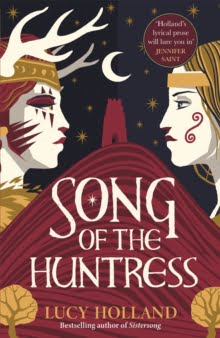
Published by Tor in April 2024
Lucy Holland’s historical fantasy novel Song of the Huntress takes us back to the English West Country that was also the setting for her previous novel, Sistersong, in an epic, gender-swapped reimagining of the story of King Herla, leader of the Wild Hunt. (You can read my review of Sistersong in Shoreline of Infinity 37)
As hinted at by the title, Song of the Huntress leads on from and bears many similarities to Sistersong; however, it is far from a mere replication of its predecessor. As in Sistersong, the story emerges through the perspectives of three different characters – the Saxon King Ine, his warrior wife Aethelburg, and Herla, the eponymous Huntress. This time round, however, most of the story is told in the third person, which frees the narration up for Holland’s often fiercely poetic prose to fully unfurl: the Folk of the Otherworld are ‘wasps in the nest of their chief’s heart’; the Dumnonian king’s eyes are ‘the peeling bark of a hazel’; and Herla, having been lured by Otherworld lord Gwyn ap Nudd’s promises of power, finds herself wielding a ‘sword with a blade darker than the space between stars’.
Huntress also plays with time in different ways from Sistersong. Two hundred years have passed since the time of King Constantine and his sisters, and the part of what was previously the Kingdom of Dumnonia we find ourselves in now belongs to the Saxon Kingdom of Wessex. Gone are the days when the pagan festivals that also structured the plot of Sistersong used to dominate the year, having been overlaid by those of the by now firmly established Christian faith. Instead, Huntress presents us with two characters who exist in two times at once: ripped from her own time and forced by Gwyn to spend centuries gathering the souls of those slain by her and her Hunters, Herla struggles to navigate the present, whereas Ine is bewildered by his visions of a past whose connection with him is not immediately apparent. Imbued with the magical powers of the Otherworld and the Land respectively, both Herla and Ine are creatures of more than one world – and both of them love Aethelburg, albeit in dramatically different ways. This mirroring draws Ine more closely into the heart of the story and cleverly establishes a connection between him and Herla, with whom his story arc otherwise overlaps very little.
While Herla struggles to remember her past, Ine seeks to repress his unbidden ancestral memories of it, and Aethelburg feels nostalgic for it (she wishes she could be a ‘proper’ warrior queen like Herla’s long-lost lover Boudica). In a similar vein, the story recalls echoes of the present to the reader in the almost-familiar names of places (Glestingaburg, Scirburne…), as well as the familiar-made-strange story of Herla the Hunter. In bringing this story to life, Holland makes use of not only a huge amount of historical research, but also the multiplicity of Wild Hunt narratives, versions of which exist over large parts of northern and central Europe. The forces of Gwyn ap Nudd, leader of the Hunt in some British versions, clash with those of the humans at a place called Wodnesbeorg (‘Woden’s Barrow’), the Germanic god Woden also being a figure often said to lead the Wild Hunt. By turning Herla, a legendary Britonic king sometimes identified with Woden who is tricked by a dwarven king to ride in the eternal Hunt, into a woman, Holland taps into yet another version of the myth: that of Perchta, an Alpine goddess of Midwinter, whom the folklorist Jacob Grimm saw as another incarnation of the Wild Hunter.
Storytellers in Holland’s books are magical, and she herself is no different. Huntress hits the perfect balance between fast-paced and reflective, and if the reader should ever be tempted to think they have the story all figured out, Holland always manages to throw them off again with her wonderfully surprising plot developments and often ‘shifty’ characters. There are two potential baddies from the start, but which one will turn out to be the main villain (or perhaps both, or neither) is not to be guessed until much later. And just perhaps, those villains might turn out to have motivations that go beyond any straightforward ‘evilness’. Nor are the protagonists as straightforward as all that – driven as much by anger and her own need to prove herself as a warrior as by her sense of duty, Aethelburg is quite happy to kill people for her husband, whereas peace-loving Ine, who prefers words to swords, is quite happy to let her. By the end, each of the three main characters will come to realise that what they each perceived to be their weaknesses may just turn out to be their biggest strengths, on the way making the reader question the meanings of concepts such as love, fertility, and identity.
Reading a book by an author whose previous book one has admired can feel like a bit of a gamble because the potential for disappointment is so much greater when the expectations are already high, and I admit I approached Huntress with a degree is wariness. But this is Lucy Holland, and I need not have worried. Huntress pretty much started for me the same way Sistersong finished: with goosebumps. If there is one thing to criticise about this book, it is perhaps that Holland still relies on familiar film tropes a little too readily, but I am disinclined to hold that against her. In fact, whereas in Sistersong, I sometimes found the movie-effect-like imagery a little jarring, Huntress’s opening chapters pulled me in so completely I not only wanted to see the film adaptation, I wanted to direct it, so clear were the images in my mind.
With Song of the Huntress, Holland has given us a hero epic for the 21st century, and in Herla a hero who, I suspect, will ignite the imagination of readers for a long time to come.
Read more reviews by Veronika on her blog.