
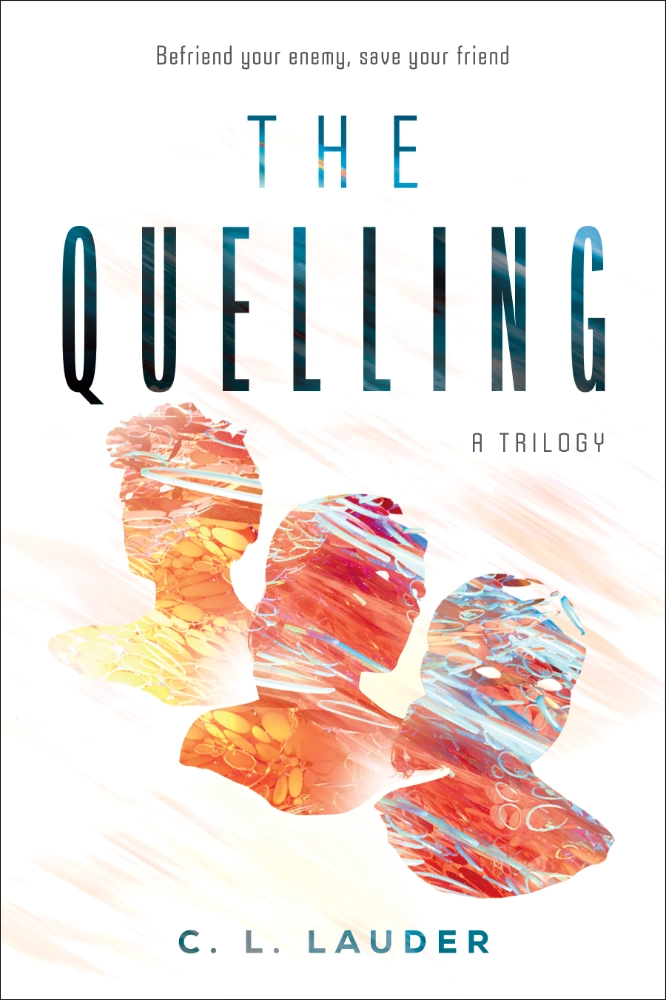
Published digital only by River Grove Books
January 2024
While The Quelling, the first book in CL Lauder’s debut Transference trilogy, has a compelling premise, its ability to explore it to the proper extent is hampered by a convoluted world and a meandering plot.
We begin on the planet Aurora Saura, and at the end of the traditional sci-fi horror story. Bodysnatching aliens invaded the year Kyjta, our protagonist, was born. By the time our story starts, most of them are fully integrated into society, thanks in large part to The Body Trust, an arrangement wherein Aurora Saurins temporarily rent out their bodies to be possessed (or ‘Quelled’) by the disembodied Rhemans in exchange for advanced alien medical technology. Not all Rhemans are happy with their dependence on the Trust, least of all the villainous Helacth. His flying Ghoragalls roam the skies looking to pick off unguarded Aurora Saurins and carry them away for use as permanent, unwilling vessels.
The story is told in alternating viewpoints, between Kyjta, an Aurora Saurin, and Kranik, a Rheman who is most frequently ‘ferried’ by Kyjta’s childhood friend Merrick. The novel follows their growing relationship, despite Kyjta’s mistrust of Rhemans, as they bond over their mission to save Calipsie, a young girl who they rescued from peril, only to watch her be swept away by a passing Ghoragall.
The Quelling is at its best when it takes the time to explore the dynamic between the Aurora Saurins, and the Rhemans and Tarrohar (another bodysnatcher species, this one native to the planet) who need their bodies to survive.
Could it ever be right to exchange another person’s bodily autonomy for your own survival? What responsibilities would you have towards that person while their body was in your possession? What could they be persuaded to accept in exchange for that trade?
The moments when these issues are addressed are unfortunately few and far between, as the numerous plot twists and regular introductions of unfamiliar concepts and characters leave little room for philosophical musing.
The story does not seem certain where it is going, and the world is so complicated— and introduced in so piece-meal a fashion— that it is often difficult to picture what is going on. For example, despite ‘moon-cycle’ being referred to as a standard unit of time throughout the novel, it is only on page 67 that we are informed that the planet actually has two moons.
There are also some more concerning issues.
Kyjta tells us at the beginning of the novel that the planet is home to only three sapient species, but later we are presented with the Ravvids, a fourth species who use language, decorate themselves with body paint, wield spears and have leaders who wear “elaborate headdress[es]”. Kyjta does not seem unfamiliar with the existence of Ravvids, and shows no qualms about killing them, or about capturing one, naming him like an animal and using him to test medicinal potions. Needless to say, the existence of a group of tribal hunter gatherers who are viewed by our main character as too culturally primitive to be considered sapient (a view that is not at all questioned by the narrative) has some uncomfortable implications.
As does a major plot point near the end of the novel, that relies on the idea that women are more valuable to Rhemans because of their inherent “mental pliability” and natural tendency to “fall in line”, a fact that we are told applies on all planets where men and women exist. In fairness, given that this information is told to us by a character whose word may not be entirely trustworthy, it is possible that Lauder is setting this concept up with the intention of subverting it later on. It is also possible, given the phrasing, that it’s intended as a commentary on the real world social pressure that women experience to ‘fit in’ and ‘not make a fuss’. Again, part of the problem here is that the high-speed narrative does not allow the reader any time to examine this idea properly before we are rushed onward to the next plot-point.
The Quelling does have its good points. The unique world it presents us with is detailed and interesting, when we are given the chance to explore it. The concept of a society made up of bodysnatching aliens and their corporeal victims is intriguing, and the resultant dystopia is well drawn. The second half of the novel, where the plot transitions to more of an old school sci-fi adventure story, reminiscent of the works of Edgar Rice Burroughs or Arthur Conan Doyle, is genuinely gripping in places.
But the novel tries to cram too many plot points and too large a world into too small a space, and the result is a story that ultimately buckles under its own weight.