
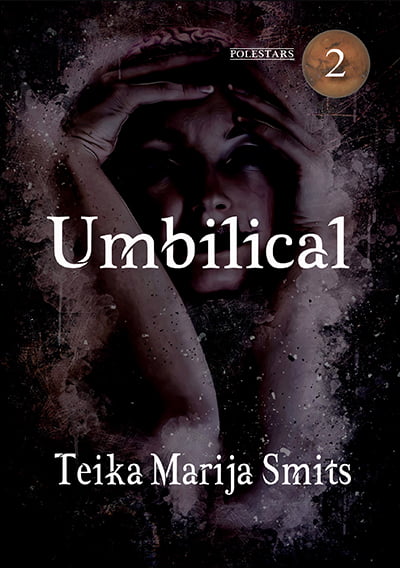
Published by NewCon Press in August 2023
Teika Marija Smits’ short story collection Umbilical could just as easily have been titled Labyrinthian, as much for its twisting, maze-like structure as for its frequent references to the myth of Theseus and the Minotaur.
Also making guest appearances are Baba Yaga, the Green Man, Bluebeard, Sherlock Holmes and Chernila— the latter being a goddess of stories and poetry who seems to the the author’s own invention.
Each story in the collection can be read as a standalone, but small details here and there suggest that several are, tantalisingly, interlinked.
The coffee-shop AI in ‘Death of the Grapevine’ describes a conversation between a writer and a woman who has read her book, the other side of which is recounted several stories later in ‘A Piece of Fabric The Size of a Pin’.
In ‘How to Honour a Beginning’, the Green Man of folklore, newly arrived on Earth, wonders “which species would be so cruel, so stupid, to rid a planet of trees?” His question appears to be answered in ‘The Green Man’, in which a group of young people attend a Green Man festival as a break from the drudgery of their dystopian, fully urbanised society.
Baba Yaga, meanwhile, appears in ‘Beginning’, alongside Chernila (who also makes an appearance in ‘Size of a Pin’ and ‘Grapevine’), and the Siren, as the crone part of the Maiden, Mother, Crone triptych. She then pops up again in ‘ATU339 the Wise’ (one of my personal favourites), circling a black hole and setting her riddles and impossible tasks to an adventurous AI, the troublesome humans having lost interest in her after the invention of space travel.
Artificial intelligences, fairytales, Greek myths and dystopian futures are interwoven throughout this anthology. In ‘Minotaur/Mindtour’ a futuristic Theseus must travel through a mental labyrinth in order to overthrow the evil king of an interstellar empire. In ‘Machina in Deo’ a group of sapient machines contemplate their own divinity. In ‘A Survival Guide for the Contemporary Princess’ the titular princess is not a princess at all, but a mafia wife whose ‘prince’ is the android guardian assigned to her by a witness protection program.
Motherhood is another theme that permeates the collection, although not quite as much as the title would suggest. ‘Umbilical’, the story that lends the collection its name, is one of the strangest, describing the physical regrowth of the umbilical chord between a mother and daughter as the former supports the latter through a terminal cancer diagnosis.
It’s a poignant image, but the practicalities at times border on the ridiculous: “Try not to freak out about it,” the daughter says, “but I have this, like, weird chord thing growing out of my belly button.”
“I’ve got one too,” her mother confesses. “Coming out of my, well… fanny.”
‘His Birth’ is another strange one. On the basis it’s a simple enough story about a woman having to choose between taking a painkiller that may cause infertility, or living with pain and clinging to her hope of having a child. The painkiller in question, though, isn’t a drug but rather a giant fish-like creature that sucks on the affected body part like a leech. (This story also features some pretty extreme medical self-harm, which squeamish readers may want to skip.)
The story that most missed the mark for me was ‘Our Lady of Flies’, about a teacher who is caught by her husband, in flagrante with one of her former students. Although everyone in the story is over the age of eighteen, the sex scene between the two of them is still somewhat uncomfortable to read, especially as the level of detail given borders on the pornographic.
My main issue with the story, though, is that after that climactic scene we somehow have over eleven pages still to go, during which nothing much happens. ‘Flies’ has the distinction of being both one of the longest stories in the anthology, and one of the least eventful.
For most of the stories in Umbilical, the shorter they are, the better they work. ‘ATU339 the Wise’ and ‘Girl’s Night Out’ (seemingly a typical story of a group of women going out for drinks, but with an unexpected dramatic twist), are just under two and five pages respectively, and yet are two of the best sci-fi stories in the bunch.
The exceptions to this rule are ‘The Case of the High Pavement Ghosts’, ‘The Eyes of the Goddess Herself’, and ‘The November Room (or Leaving the Labyrinth)’ all three of which benefit from a longer length that allows Smits to properly stretch her imaginative wings.
‘Ghosts’ tells the tale of Sherlock Holmes’s ghost-hunting female cousin, who is summoned by the detective when one of his cases starts to show elements of the supernatural. The characters in this story and the set-up of the central mystery are compelling, and the ghosts themselves a chilling presence. Unfortunately, the ending does fall off a bit (in fairness, a failing that it shares with a fair few of the Conan Doyle originals).
‘Eyes’ is an otherworldly fable about a young woman whose artistic talent provokes supernatural sabotage by a jealous husband. This story is probably the one that benefits most from the extra space, allowing the author to weave a compelling mythology around the world her protagonist lives in.
‘November Room’ is the final story, and the spiritual, if not literal, sequel to ‘Minotaur/Mindtour’, featuring a woman trapped in a mysterious labyrinth that forces her to relive various moments from her life in the aftermath of a great personal tragedy. This story’s strength comes in its piecemeal revelation of the facts via a series of flashbacks, and the extra length allows it to do this to great effect.
Umbilical is a labyrinth that lures the reader in and tempts them to find its centre. Explorers are advised to look out for minotaurs, and to leave a tangle of yarn behind them, lest they lose their way in the dark.