
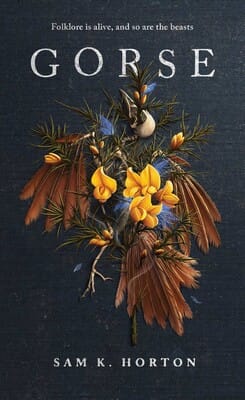
Published by Solaris in September 2024
It is 1786. Near the Cornish village of Mirecoombe, a young man’s body is pulled from the mire, the fifth in a series of unexplained violent deaths. Though not seeing eye to eye on much else, the Reverend Jacob Cleaver and his friend-cum-adversary, the mysterious, grumpy Pelagius ‘Pel’ Hunt, agree on one thing: the killer is a human, and not one of ‘Them’, the piskies, spriggans and other spirits inhabiting the surrounding moor. As Keeper, it is Pel’s job to maintain the fragile balance between Them and the people of Mirecoombe – but can Pel and his witchy young ward Nancy Bligh find the killer before fear and suspicion destroy the balance and tip the village into chaos?
Sam Horton’s debut novel Gorse had me firmly in its peaty clutches from the very first lines. Horton writes in a style that is haunted by death as much as by beauty, managing to conjure a sense of foreboding so thick with the cloying spirit of the moorland landscape it is set in one can practically feel the mist drawing in as one reads. This is a landscape steeped in magic and myths, a landscape of ghosts (those of people as well as of stories), in which Horton’s writing seems to be just as at home as his captivatingly complex characters.
Against the murky, earthbound world of the moor and its fey mirror dimension, the Undermoor, sits the detached figure of the Christian God in his ‘house on the hill’, whose very indifference and unresponsiveness seem to reinforce his appeal to the locals as an antidote to the danger and tricksiness bound up with their dealings with the fairy realm. Much as Pel tries to create a space for the new religion within the balance of relationships he has sworn to maintain, this aloof God doesn’t tolerate any rivals – and neither does the Reverend Cleaver, who has his own personal motivation for his hostility towards Pel and the old ways he represents.
With the locals’ divided loyalties to the old faith and the new creating tensions within the community, Pel and Nancy’s investigation is further complicated by the repressed rivalry between them. Pel, who had to work hard and make great sacrifices for his magic and his ability to communicate with Them, is jealous of Nancy’s natural gift, which he knows far exceeds his. Nancy, meanwhile, resents Pel for gatekeeping his knowledge of and interactions with Them, which she sees as patronising. When Pel disappears and it is up to Nancy to bring their case to a close, the disadvantage of Pel’s overprotectiveness becomes obvious – though not only in Nancy’s dealings with the fairies: the locals, it turns out, can be just as hard to navigate – and just as lethally dangerous.
Horton, who states that his literary talent came as a ‘surprise’ to him, writes with an irreverence for the ‘rules’ that is as unsettling as it is refreshing. The punctuation and resulting number of half-sentences is dizzying throughout, and he quite happily repeats words and phrases within the same short passage. None of this, however, detracts in the slightest from the spellbinding quality of the writing. In fact, I got the impression that Horton was quite openly casting his spell on his readers: with its chapters mostly named after local plants, Gorse in a way replicates Pel’s book of spells, which features pressed flowers with incantations attached to them that make the moor ‘listen’. The only points where I felt jolted out of the story were a few instances in which characters uttered a somewhat anachronistic ‘Okay.’
Nonetheless, to say that Gorse is an immersive read would be an understatement; more than that, I practically felt submerged in it. There is a scene around a third into the story in which a character is described sinking into the peat that left me feeling quite breathless: ‘[He] can feel the moor working its way in… a symphony of rot, ages of bone and blood and flesh transmuted into peat, into soil. It fills and clogs his nostrils, his ears and with every fibre of his being he tries not to resist…’
While thematically reminiscent of recent fantasy novels such as Stephen King’s Fairytale or Kit Whitfield’s In the Heart of Hidden Things, stylistically, Gorse is entirely its own thing – as well as being staggeringly beautiful. Though Horton has written about the difficulty of finding a publisher for a book ‘too literary for the fantasy crowd, too fantasy for the literary crowd,’ it is, ironically, precisely this combination that makes it so exciting and unique. Whether you enjoy witchy historical fantasy or folk horror, or you just love luxuriating in good writing, this is absolutely the book for you.
And if, by the end, you find that Gorse’s close to 400 pages still weren’t enough, there is good news: its sequel Ragwort is already in the works.