
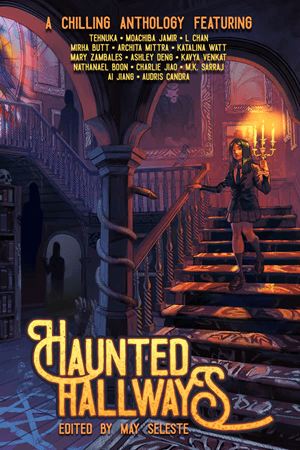
Published by Outland Entertainment in April 2024
Somewhere, deep in the English countryside, stands the Mallory Thorne School of Excellence. Founded in the Victorian Era, and helmed by a succession of headmasters and mistresses— all members of the illustrious Thorne family— the school’s history is characterised by good exam results and ghostly activity.
This is the setting for Haunted Hallways, an anthology of horror stories connected by a common setting and a constant sense of unease.
The effect is to give the impression that the school, appropriately enough for a haunted building, is somewhat unbound by time and space. Although the authors were given a basic history and description of Mallory Thorne before they began, to ensure at least some consistency, the result of giving the same prompt to fourteen different authors is to have produced fourteen different schools.
In ‘The Magic That They Never Taught Us’ and ‘Twin Daggers’ (the first two stories in the anthology), for example, the magical nature of the school is something that the pupils are well aware of, while the staff remain either stubbornly oblivious or actively in denial. However, in later stories such as ‘Saints of Stained Glass’ and ‘A Memory Left Fighting’, the staff are if anything more aware than the students are, and take an active role in dealing with the incidents of paranormal activity that threaten their charges.
When seeking contributors, May Seleste, the editor of the anthology, sought to amplify the voices of Asian writers. Although the themes of identity, colonialism and racism were not part of the original brief given to authors, their shadows hang over the stories all the same. ‘Renewal Notice’ and ‘The Housemaster’s Cure’, among others, present Mallory Thorne as having a majority white student body, as a way of emphasising the idea of the British boarding school as a tool of colonialism and white supremacy. ‘The Summoning’ and ‘Behind The Eyes’, however, choose to take this opportunity to explore how different cultural identities might interact with the traditionally Western European gothic horror genre, and so present the school as relatively diverse.
This range of perspectives is also reflected in the nature of the paranormal creatures that the characters encounter. In ‘The Magic They Never Taught Us’, a group of girls use an Indonesian Jelangkung ritual to summon a spirit in their dorm room, and then struggle to send it back. Dark deeds and hidden secrets are exposed in ‘Remain Nameless’, when a Kaperosa (a ‘White Lady’ ghost from the Philippines) appears in the school lake. In ‘Breaking Into Finals’, a student’s decision to get ahead in a public speaking competition, by making a deal with the semi-demonic Rakshasa, is interwoven with a retelling of the Hindu story of the asura, Hiranyakashipu’s, attempts to challenge the god Vishnu.
Perhaps the most poignant example is in ‘Renewal Notice’, where a student fleeing the Sri Lankan Civil War is suddenly confronted by Tamil-speaking spirits from back home who beg her for help, in a story that plays with the fact that the Tamil word “aavi” can refer to either spirits or steam.
Real world horror certainly plays its part in these stories, with issues explored including racism, honour killings, sexual assault, child abuse, war, self-harm and suicide. Trigger warnings are provided at the beginning of each story, and I would advise any reader to pay attention to them. Several stories contain graphic descriptions of characters undergoing physical torture, supernatural or otherwise, some of it self-inflicted.
This doesn’t however, mean that the anthology lacks a lighter side. In ‘Saints Of Stained Glass’, for example, two girls must fight the terrifying creatures that emerge from the chapel windows, by using the power of K-Pop. In ‘The Choir Room’, a vengeful ghost celebrates her killings with a rendition of ‘He Had It Coming’ from the musical Chicago. ‘A Memory Left Fighting’, one of my personal favourites, takes a more traditional approach in terms of subject— a supernatural serial killer stalking the school— but with a snarky, ghost-hunting protagonist who wouldn’t be out of place in a Young Adult novel.
Like all anthologies, Haunted Hallways is somewhat hit or miss. With such a variety of stories, after all, it would be impossible for all of them to please everyone. (Personally, ‘The Choir Room’ veered a bit too much into the camp for my taste.) In this reviewers opinion, however, the hits most definitely outnumber the misses. I certainly wouldn’t recommend becoming a student at Mallory Thorne— far too much pressure to succeed, combined with far too many ghosts and ghouls— but for those willing to brave the halls for an hour or two’s visit, this anthology is a terrifyingly good read.